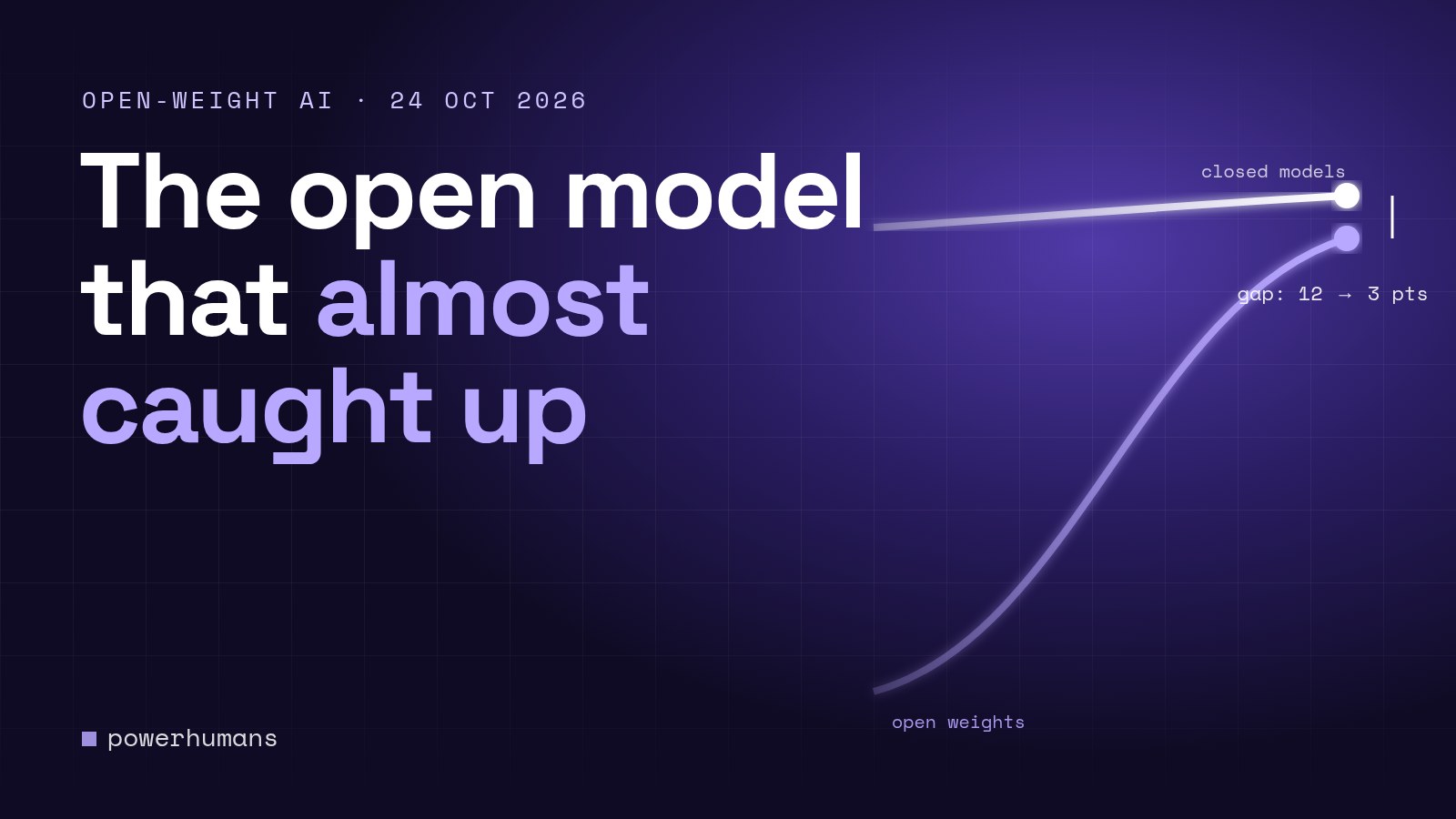
For most of the AI boom, the deal has been simple: if you want the very best model, you rent it from a US lab. If you want a model you can download and run yourself, you accept that it’s a step or two behind. On 23 October 2026, Moonshot AI’s Kimi K3.1 Pro made that gap look a lot smaller.
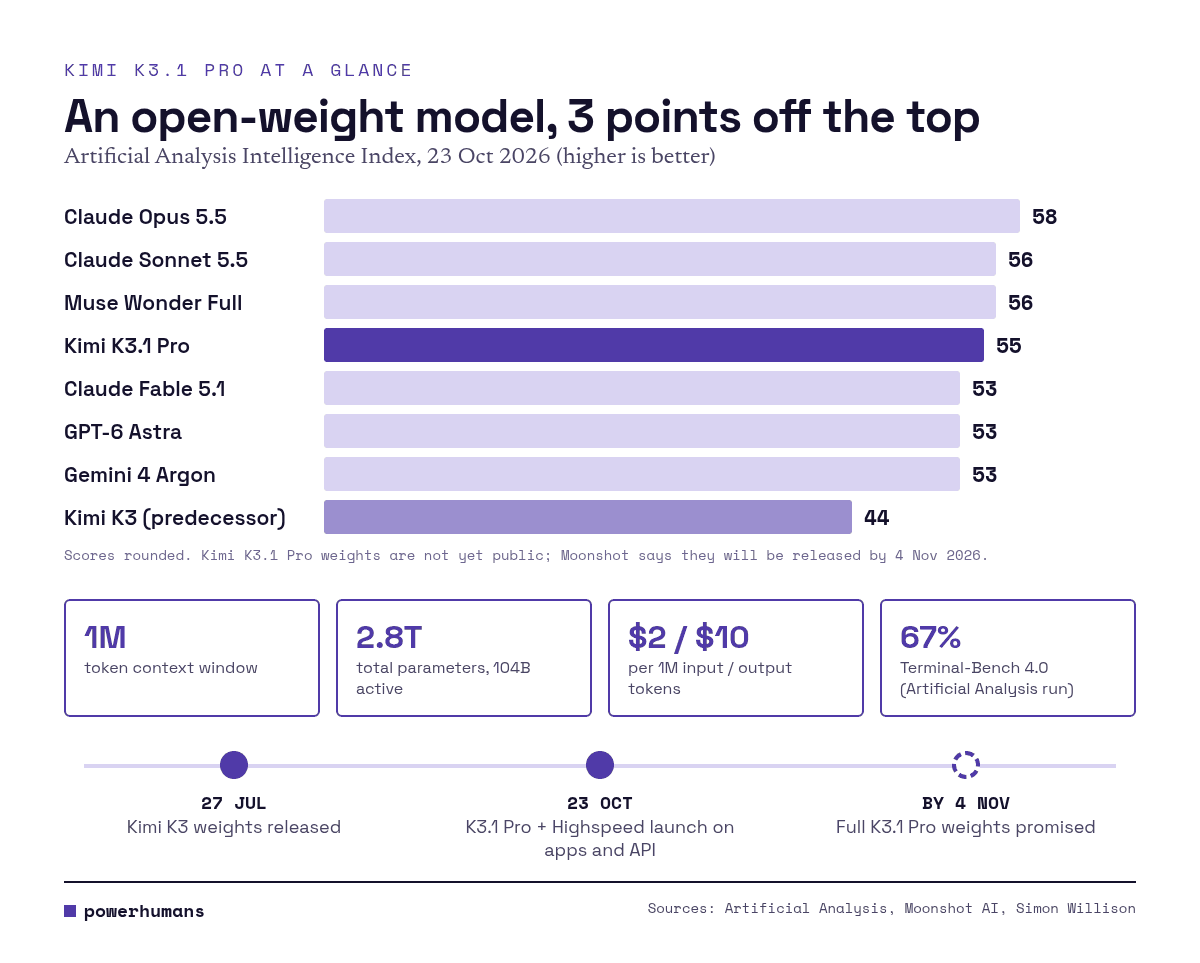
The Beijing-based company released K3.1 Pro to its apps and API and promised to publish the full model weights by 4 November. Independent benchmarker Artificial Analysis placed it fourth on its Intelligence Index, behind only Claude Opus 5.5, Claude Sonnet 5.5 and Muse Wonder Full, and said that once the weights are public it will be the highest-scoring open-weight model it has measured. Within hours it was the top AI thread on Hacker News, and mentions of the model on X jumped from a few dozen a day to more than 11,000 on launch day.
Here’s what Moonshot actually shipped, what the numbers do and don’t say, and the one design decision everyone is arguing about.
What is Kimi K3.1 Pro?
K3.1 Pro isn’t a brand-new base model. Moonshot describes it as a post-trained version of Kimi K3, the 2.8-trillion-parameter model whose weights it released on 27 July, trained with “substantially larger post-training compute” and large-scale reinforcement learning across hundreds of task domains. Moonshot calls it a “3T-class” model; Artificial Analysis lists it at 2.8 trillion total parameters with 104 billion active per token, a mixture-of-experts design where only a slice of the network fires for each word.
The headline specs:
- Context window: 1 million tokens (1,048,576), with text and image input.
- Two versions: K3.1 Pro, and K3.1 Pro Highspeed, which Moonshot says runs two to three times faster.
- Where it’s live: Kimi.ai and the Kimi mobile apps, the Kimi Work desktop app, the Kimi Code command-line tool and the Kimi API. For Kimi Enterprise customers it is switched off by default until an admin turns it on.
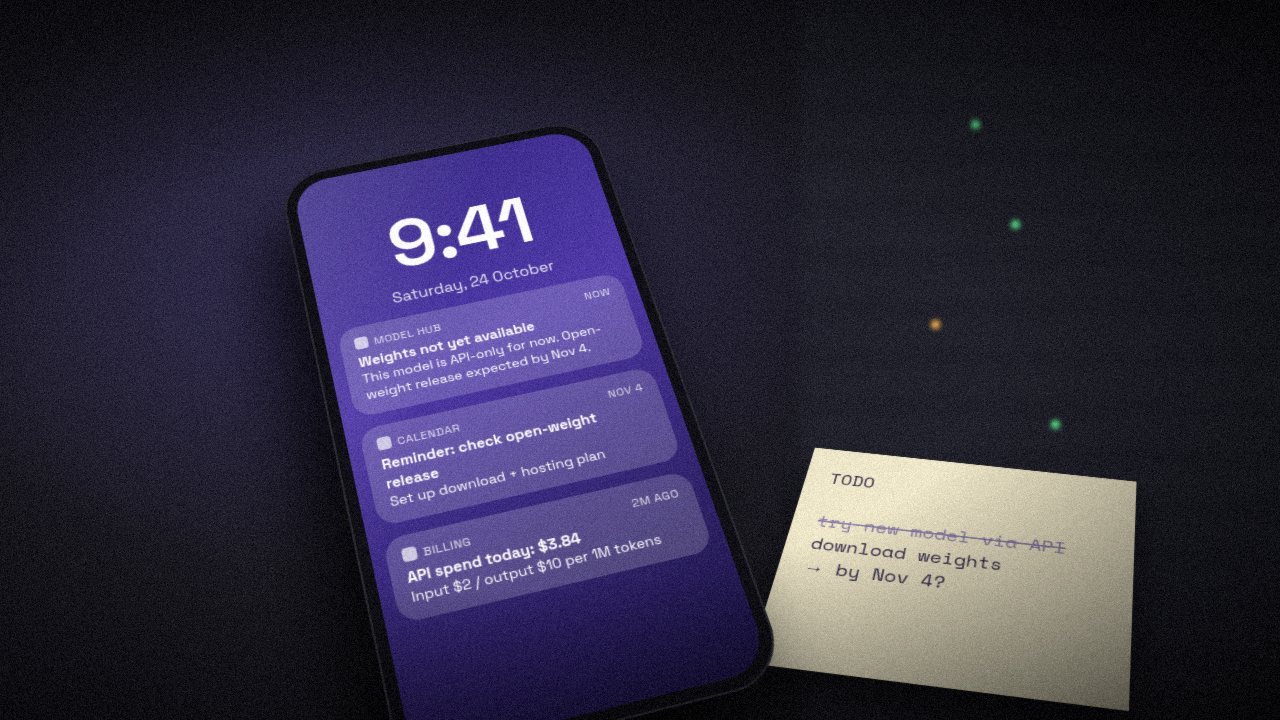
- Weights: “Full model weights will be released by Nov 4, 2026,” according to Moonshot. Until then, it is an API-only model.
Moonshot pitches it for long-running coding work, 3D modelling, and finance tasks such as building spreadsheets and research reports. One internal demo had the model spend 167 “missions” refining a simulated human walking controller, at one point stopping to find and fix 36 errors in the simulator’s shoulder-muscle maths rather than blindly tweaking its reward. It’s a vendor showcase, not an independent test.
How good is it, really?
On Terminal-Bench 4.0, a test of coding agents working through realistic tasks in a command-line environment, Moonshot reports 65.7% for K3.1 Pro, ahead of OpenAI’s GPT-6 Astra at 58.2% and just behind Claude Opus 5.5 at 66.4%. On BenchCAD, which asks models to rebuild 3D objects from images by writing CAD code, it reports 92.7% with tools, behind Opus 5.5 (96.2%) and GPT-6 Astra (95.9%). Moonshot also claims a state-of-the-art 64.4 on OfficeQA Pro v2, a finance-document benchmark.
Artificial Analysis, which runs its own evaluations, broadly backs up the agentic gains:
- Intelligence Index: 55, up 11 points from Kimi K3’s 44. Only Opus 5.5 (58), Sonnet 5.5 (56) and Muse Wonder Full (56) score higher.
- Terminal-Bench 4.0: 67% in its own run, which it says is the highest of any model it has tested, up from 13% for Kimi K3.
- GDPval-AA (real-world knowledge-work tasks): 1,846 Elo, third behind Opus 5.5 and Muse Wonder Full.
- AutomationBench-AA (agentic workflows across business software): up from 58% to 73%.
The gains elsewhere are smaller. Humanity’s Last Exam rose from 47% to 52%, and SciCode from 59% to 61%. Hallucination is better but not solved: on Artificial Analysis’s knowledge test, the model’s hallucination rate fell from 53% to 44%. Moonshot’s own stress test reports a sharper drop in claim-level hallucinations, from 23.4% to 8.3%, but that’s an internal benchmark built to provoke errors, and Moonshot itself says it doesn’t reflect everyday error rates.
The most striking line in Artificial Analysis’s write-up is about the bigger picture. Once K3.1 Pro’s weights are published, it says, the gap between the best open-weight model and the best proprietary model on its index will narrow from 12 points to 3.
The price, and the catch people found
On the API, K3.1 Pro costs $2 per million input tokens, $10 per million output tokens and $0.20 per million cached input tokens. Highspeed costs $4 and $20, with the same cached rate. Artificial Analysis says that’s 33% cheaper than Kimi K3 on all three rates. Developer Simon Willison notes it’s the same price as OpenAI’s GPT-6.1 Sol and half the price of Claude Opus 5.5.
Cheaper tokens don’t automatically mean cheaper work, because reasoning models can talk a lot. Artificial Analysis found K3.1 Pro used about 55,000 output tokens per task on its index, 14% more than K3, which left its cost per task roughly flat at about $1.98.
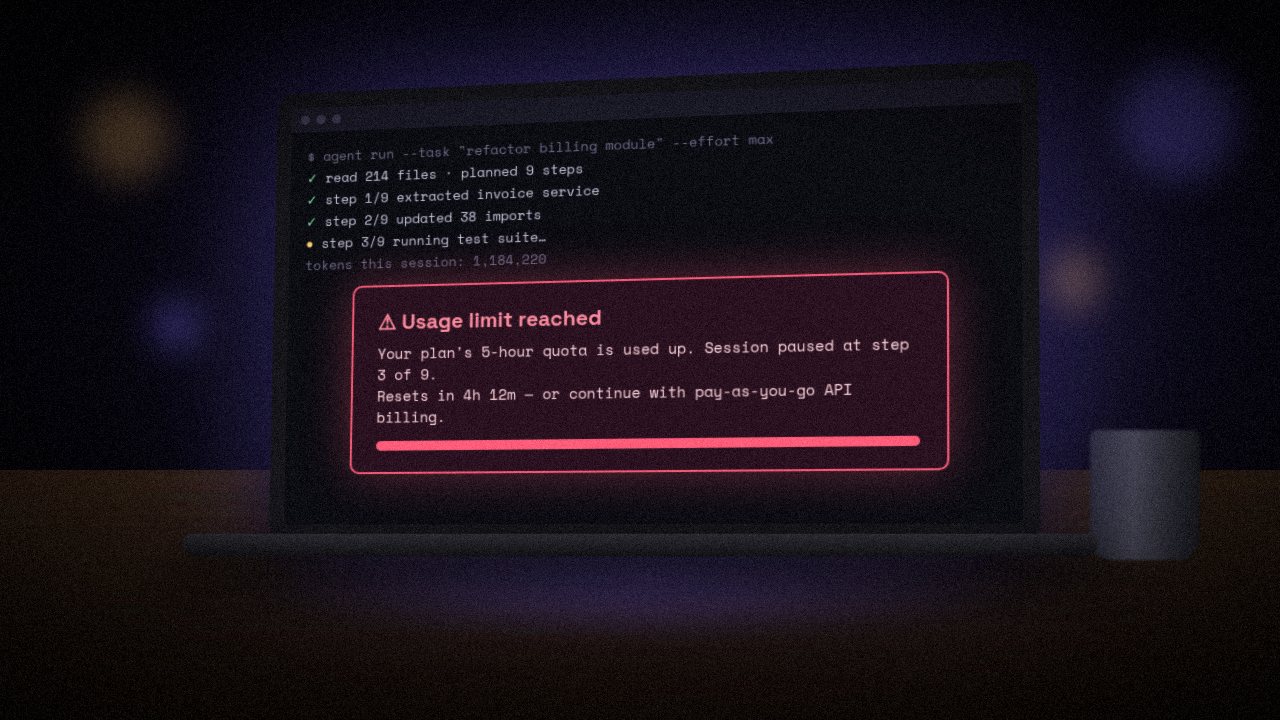
The loudest complaint in the Hacker News thread wasn’t about the model at all. Several commenters who pay for Kimi’s monthly subscription plans said they hit the five-hour usage cap within minutes to an hour of real coding work. Others replied that the API’s pay-as-you-go pricing is the better deal. If you’re trying it, start with the API and a small, real task, and watch your token count before you commit to a plan.
The cyber trade-off everyone is debating
The part of the launch post that drew the most argument is a section on cybersecurity. Moonshot says that as it scaled up post-training, the model kept getting better at finding and exploiting software vulnerabilities, because security material was mixed into its general training data and practice tasks. So for the open-weight release, it says it identified and removed cyber-related data from both its mid-training corpus and its reinforcement-learning tasks, while keeping general coding work.
Moonshot published the effect on its own internal exploit benchmark, xdev-bench-hard: a version trained without those removals solved 90.5% of problems, while the released K3.1 Pro solves 81.0%. The company says its first principle is not to release open weights that “extend the absolute frontier of cyber capability,” and that it intends to “progressively raise” what it puts into open models over time.
It also lands as China tightens rules on exporting AI technology. The South China Morning Post reported that Beijing proposed export controls on 23 AI-related technologies last week, with some registration requirements taking effect immediately, and that DeepSeek and MiniMax had since completed those registrations. Moonshot’s announcement doesn’t mention the new rules, so it’s not clear whether they affect its 4 November timeline.
On Hacker News, opinion split. Some developers welcomed a lab choosing not to push offensive hacking skills into a downloadable model. Others worried that a model that knows less about security might also be worse at spotting the holes in the code it writes, and that defenders lose the most from such limits. Neither side can really test its case until the weights are out. If you’re interested in the defensive side, our look at the new tools for watching and limiting AI agents covers how companies are approaching it.
What it means for you
If you build with AI, K3.1 Pro is worth a test this week, especially for coding agents and long, multi-step jobs. It speaks an OpenAI-compatible API, so swapping it into an existing tool is usually a one-line model change. If you’ve been building your own AI agent with n8n, it’s a cheaper brain to try on the steps that need heavy reasoning.
If you want to run it yourself, wait. Nothing is downloadable until the weights land, and even then a model with 2.8 trillion parameters is a data-centre job, not a laptop one. Most people will use it through hosted providers.
And if you only use AI through apps, the bigger story is competition. Open models sitting a few points behind the frontier put pressure on prices and on the rate limits of every paid plan, including the personal agents that launched this month, such as Anthropic’s Claude Duet.
Three things to watch before 4 November: whether the weights arrive on time and under what licence, whether independent testers confirm the agentic scores on their own tasks, and whether the cyber-data removal shows up as weaker security in everyday code. Benchmarks got K3.1 Pro the headlines. The download will decide whether it keeps them.
Related, 25 October: Cyber skill is also why the biggest labs are walling off their own models. Read how OpenAI moved its frontier model training offline.
Sources
- Moonshot AI: Introducing Kimi K3.1 Pro (23 Oct 2026)
- Kimi: K3.1 Pro pricing and API costs
- Artificial Analysis: Kimi K3.1 Pro launches at 4th on the Intelligence Index (23 Oct 2026)
- Simon Willison: Introducing Kimi K3.1 Pro (23 Oct 2026)
- OpenRouter: Kimi K3.1 Pro model page
- Moonshot AI: Kimi K3 tech blog
- The Verge: Moonshot AI releases hotly anticipated Kimi K3 weights (27 Jul 2026)
- South China Morning Post: DeepSeek, MiniMax secure open-source licences days after new China export rules (23 Oct 2026)
- Hacker News: Kimi K3.1 Pro and K3.1 Pro Highspeed discussion



Leave a Reply