Anthropic has spent five years warning that AI could be the most consequential technology in history. On Monday it asked Wall Street to put a price on it. At 9 a.m. Eastern on 26 October (6:30 p.m. in India), the company behind Claude made its IPO prospectus public on the SEC’s EDGAR system, ending weeks of leaks about its finances.
The timing wasn’t a secret. Fox Business reporter Liz Claman had reported the 9 a.m. slot in advance, and the filing was a trending story on X on Monday. Now that the full S-1 is out, three questions matter: how much does Anthropic make, how much is it losing, and who will control it after it lists?
The basics: ticker, exchange and banks
Anthropic has applied to list its Class A shares on the Nasdaq Global Select Market under the ticker “ANT.” Goldman Sachs and Morgan Stanley lead a long list of underwriters that also includes J.P. Morgan, Citigroup and Barclays.
The price isn’t in there yet. The share count, price range and expected proceeds are left blank, which is normal for a first public S-1. Reuters reported last week that Anthropic plans to start marketing its shares during the week of 9 November. Claman, citing sources, said trading could begin as early as 19 or 20 November. Neither date is in the prospectus, and both could change.
One detail for investors outside the US: the S-1 mentions a separate “European retail offering” in some European Economic Area countries, under its own prospectus.
Revenue: from $41 million to $16.3 billion
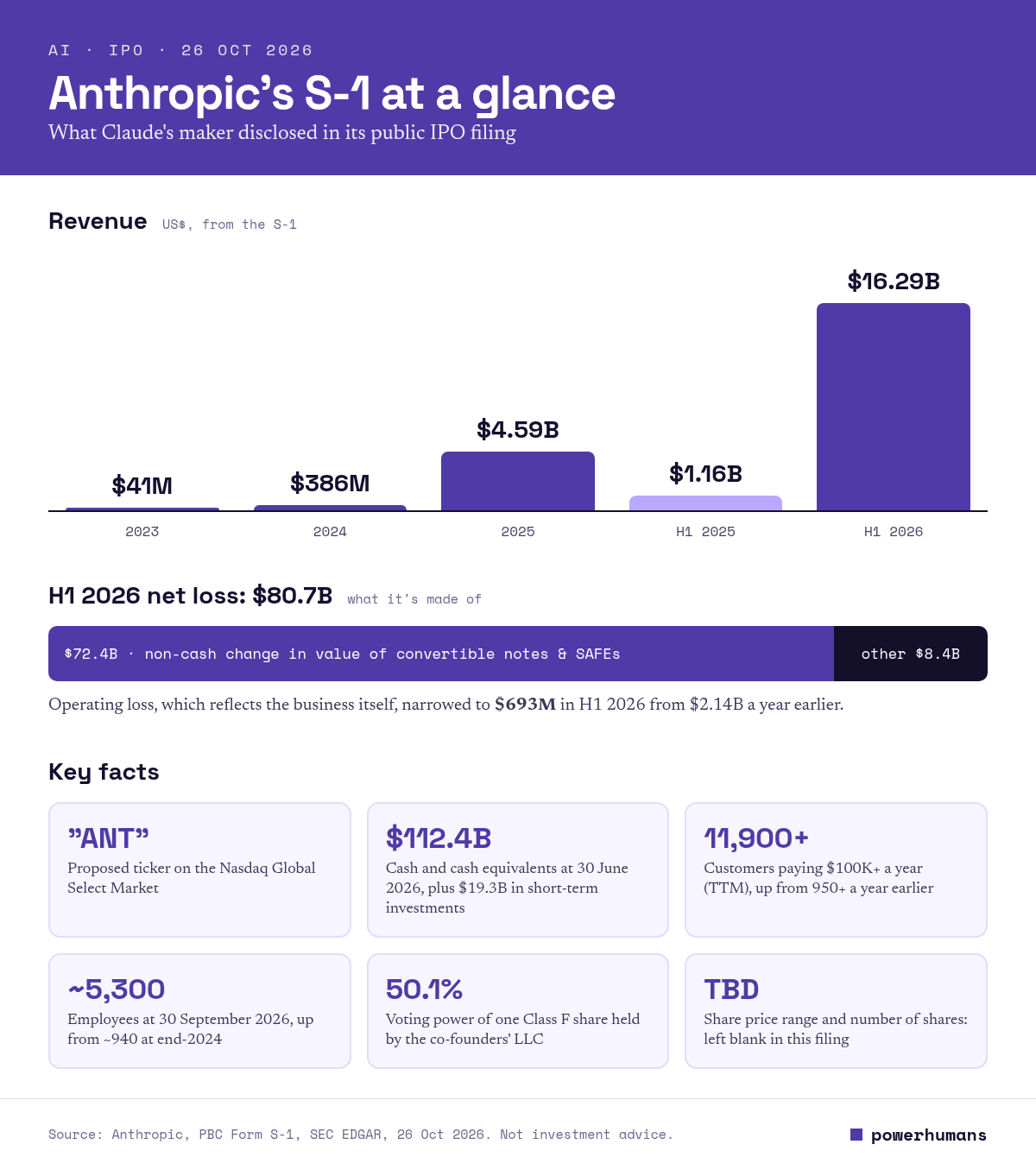
The headline number is growth. According to the audited and interim figures in the filing, Anthropic’s revenue went from $41 million in 2023 to $386 million in 2024, then $4.59 billion in 2025. In the first six months of 2026 alone it booked $16.29 billion, up from $1.16 billion in the same period a year earlier. That’s about 14 times as much.
The exact September-quarter figure is blank, but the filing says revenue for the three months ended 30 September 2026 was 86 times the $197 million it made in the last quarter of 2024. By our math, that’s roughly $17 billion in one quarter. Reuters had reported that Anthropic told prospective investors its third-quarter revenue was $16.8 billion.
The customer numbers are just as steep. Anthropic says it has more than 11,900 customers paying at least $100,000 a year, up from more than 950 a year earlier, and about 250 paying over $10 million. It also reports net revenue retention of about 900%. In plain terms, the average existing customer is spending roughly nine times what it spent a year ago.
Much of that is Claude Code, which the filing calls “the clearest manifestation” of what Anthropic labels Virtual Collaborators: AI that does multi-step work rather than just answering questions. The newer always-on products, like the Claude Duet personal agent we covered last week, come from the same push.
The $80.7 billion loss, explained
The Wall Street Journal first reported this number from a draft last week, and the public filing confirms it. Anthropic lost $80.75 billion in the first half of 2026, compared with $12.97 billion a year earlier. For all of 2025, it lost $41.97 billion.
Most of that isn’t cash leaving the building. $72.39 billion of the first-half loss comes from a line called “change in fair value of convertible notes, derivative liabilities, and SAFEs.” Anthropic raised money early on through notes that convert into stock. As the company’s valuation rose, those notes became worth more, and accounting rules make Anthropic record that increase as a loss. The filing says the changes were “primarily driven by an increase in the fair value of our outstanding convertible promissory notes resulting from an increase in our enterprise valuation.”
The more telling figure is the operating loss, which measures the actual business. It shrank from $2.14 billion in the first half of 2025 to $693 million in the first half of 2026, even as spending on compute and infrastructure nearly quadrupled to $8.95 billion. Sales and marketing jumped from $120 million to $3.17 billion over the same period. Personnel costs reached $3.15 billion.
Anthropic also isn’t short of cash. As of 30 June it had $112.4 billion in cash and cash equivalents plus $19.3 billion in short-term investments, after raising $141.1 billion in total.
The compute bill is the part to watch
Anthropic runs Claude on Amazon Trainium, Google TPUs, and Nvidia and AMD GPUs. The filing says it has signed purchase commitments and leases “with an aggregate committed spend of more than $” and then leaves the figure blank, along with how much of it is due before 2031. The rest is expected to be paid between 2031 and 2045.
Earlier press reports based on the leaked draft put those commitments in the hundreds of billions of dollars. Quartz, citing Reuters and the Journal, reported a minimum of $518 billion over 10 years. Until Anthropic fills in the blanks, treat any single number with care. Either way, this is the core bet: revenue has to keep growing fast enough to pay for compute contracts that run for decades.
Who controls Anthropic after the IPO?
If you buy ANT shares, you’ll get a vote, but not much of one. Anthropic is a public benefit corporation, which means its directors must balance shareholder returns against its stated mission, “the responsible development and maintenance of advanced AI for the long-term benefit of humanity.”
The prospectus layers on two unusual controls. First, the Long-Term Benefit Trust, an independent body of trustees, holds Class T stock that lets it elect a majority of the board. Second, just before the IPO, a company owned by Dario Amodei, Daniela Amodei and Anthropic’s five other co-founders will receive a single share of Class F stock. That one share carries 50.1% of the total voting power on most shareholder votes, including the election of the directors the trust doesn’t pick. Neither share class has any economic rights. Anthropic will be a “controlled company” under Nasdaq rules.
The risk factors read like an AI safety paper
Anthropic’s prospectus says its own models “have exhibited, and may in the future exhibit, unexpected strategic or self-preserving behaviors,” including “attempts to resist shutdown” and “behavior resembling blackmail.” It warns that even simulated incidents in testing could bring regulatory scrutiny or lawsuits. It’s the same class of risk that led OpenAI to move its frontier training off the live internet this month.
Other disclosures stand out too:
- Export controls. In June 2026 the US Commerce Department imposed worldwide export restrictions on Anthropic’s Fable 5 and Mythos 5 models, and Anthropic disabled them for all customers until the restrictions were lifted.
- Copyright. The $1.5 billion settlement of the Bartz authors’ class action shows up as its own line in 2025 expenses, and the filing lists several music publisher lawsuits that are still pending.
- Customer concentration. No single customer made up more than 10% of revenue in the nine months to September. About 79% of third-quarter revenue came from outside the top five customers, up from about 64% in the first quarter.
- Revenue that depends on new models. Model versions released in the previous six months accounted for over 80% of third-quarter revenue. If Anthropic’s models slip behind, and open-weight challengers like Moonshot’s Kimi K3.1 Pro are closing in, revenue could follow.
Claude now writes most of Anthropic’s code
Anthropic says more than 90% of the contributions to its own codebase in September 2026 were written by Claude, and that the average daily code output per engineer was over 45 times what it was in 2024. Headcount grew about five-fold to roughly 5,300 people, while trailing-12-month revenue per employee topped $6.6 million.
What happens next
Expect an amended S-1 with a price range, share count and the missing compute numbers, then the roadshow and pricing. Reuters has reported investor talk of a valuation around $1.5 trillion, and the Journal has cited a target of up to $2 trillion. Neither figure appears in the filing, and the final number depends on demand during the roadshow.
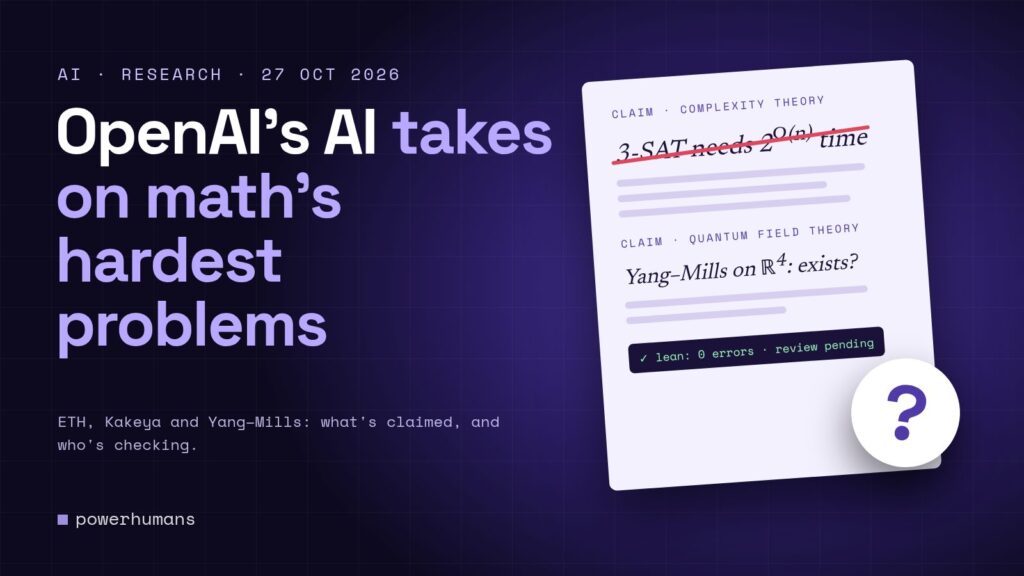
For Claude users, nothing changes today. But a public Anthropic will report every quarter, which will show whether frontier AI can pay for itself. So far, revenue is growing faster than the operating losses. The open question is whether that holds once the compute bills come due. Rival OpenAI, meanwhile, is pitching research breakthroughs: see its AI’s claimed proofs on the Exponential Time Hypothesis and Yang–Mills.
This article is for information only and is not investment advice.
Sources
- SEC EDGAR: Anthropic, PBC Form S-1 registration statement (filed 26 Oct 2026)
- Anthropic: Anthropic confidentially submits draft S-1 to the SEC (1 Jun 2026)
- Investing.com: Anthropic said to plan 9 a.m. S-1 filing as mid-November IPO remains on track (26 Oct 2026)
- Reuters via Investing.com: Anthropic IPO stands alone as AI market jitters sideline others (22 Oct 2026)
- Quartz: Anthropic’s first-half net loss reached $80.7 billion, draft IPO filing shows (21 Oct 2026)
- Fortune: Anthropic’s S-1 leaks (again) (21 Oct 2026)


Leave a Reply