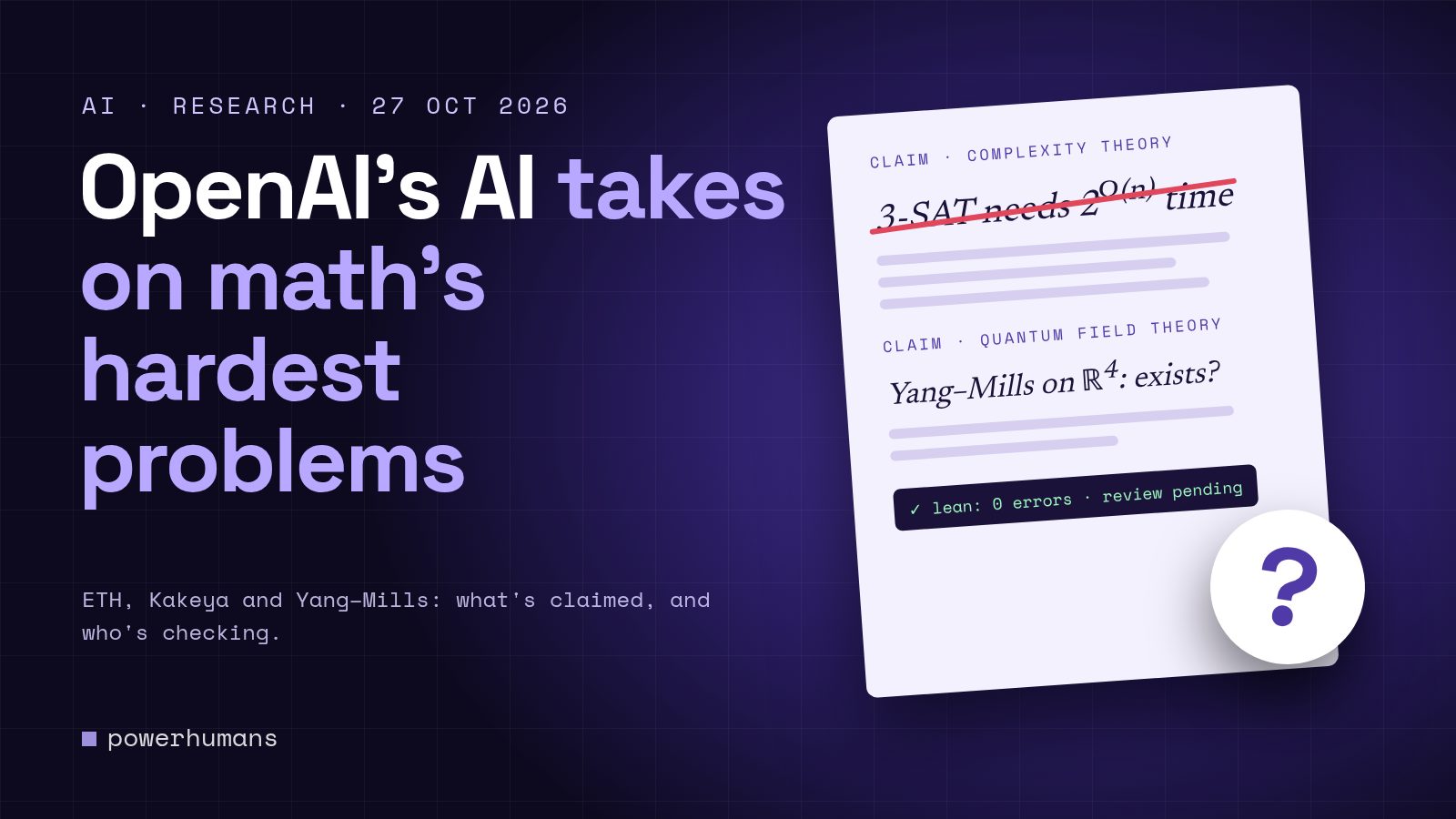
Some problems in mathematics and computer science have resisted the best minds for decades. On 26 October 2026, OpenAI said an unreleased internal model had made progress on three of them at once. It claims the model refuted a 27-year-old conjecture about how hard computers find logic puzzles, proved a famous conjecture about waves in every dimension, and produced a rigorous existence proof for the quantum field theory behind the strong nuclear force.
If even one holds up, it’s a big deal. None has been independently confirmed, and the physics proof hasn’t been released at all. Here’s what OpenAI is claiming, who’s checking it, and why mathematicians are pushing back.
What OpenAI announced
The announcement describes three results, in harmonic analysis, complexity theory and quantum field theory. OpenAI calls the AI-written manuscripts “a form of raw research data” and says it does “not seek academic credit” for them.
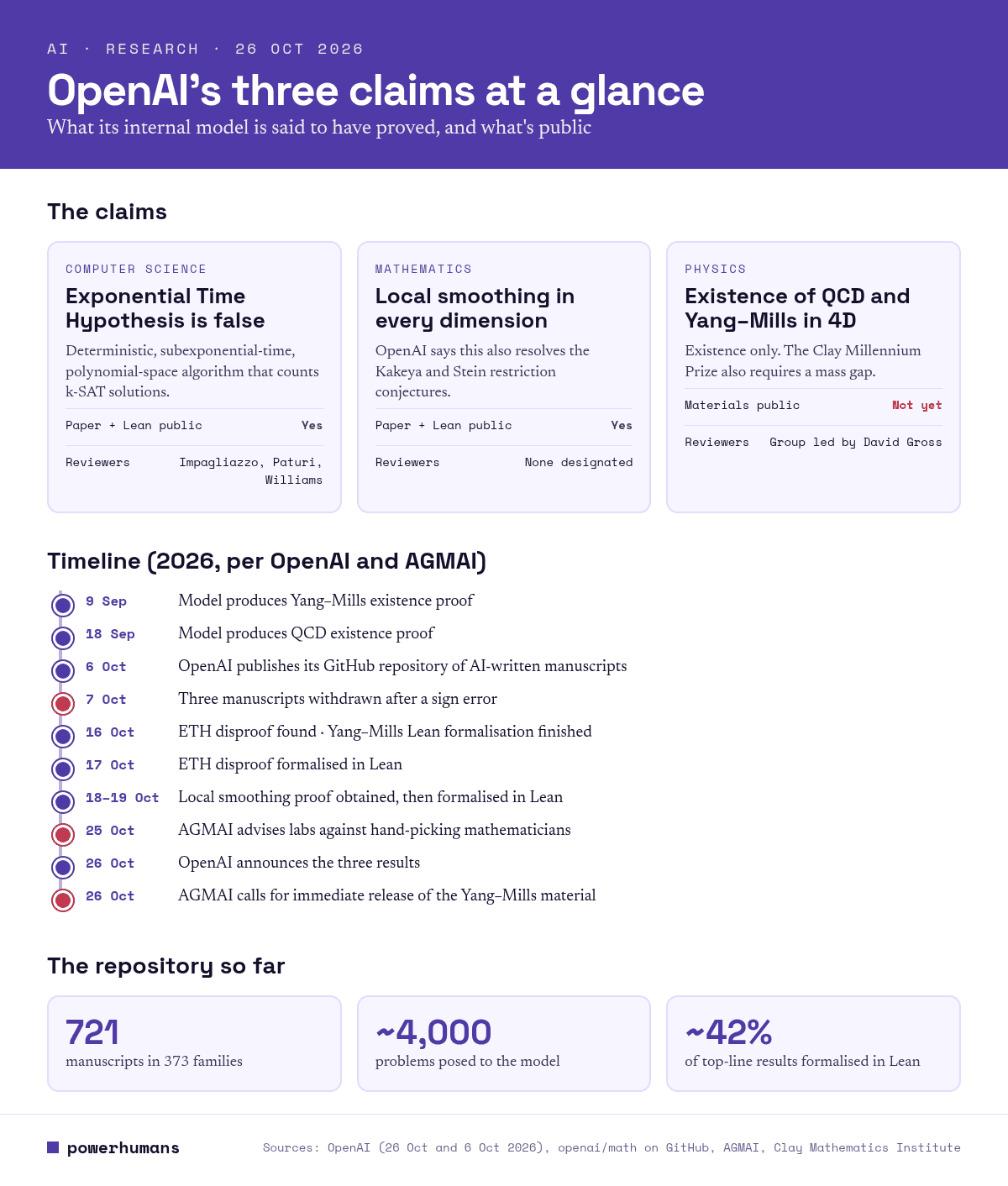
What’s new is the release process. For each result, OpenAI asked outside experts to act as “shepherds,” and they chose different ways to handle it:
- Math: release the AI output publicly and let researchers organise their own efforts to explain it.
- Computer science: form an external group to explain the result, and publish the AI write-up and its Lean proof immediately.
- Physics: form an external group, hold back the AI-produced artifacts, and let the group write the result up itself.
The story spread fast. OpenAI’s post and the ETH paper were the top two stories on Hacker News on Tuesday morning (India time), and reviewer Ryan Williams’s X thread passed about 700,000 views within hours.
The headline claim: the Exponential Time Hypothesis is false
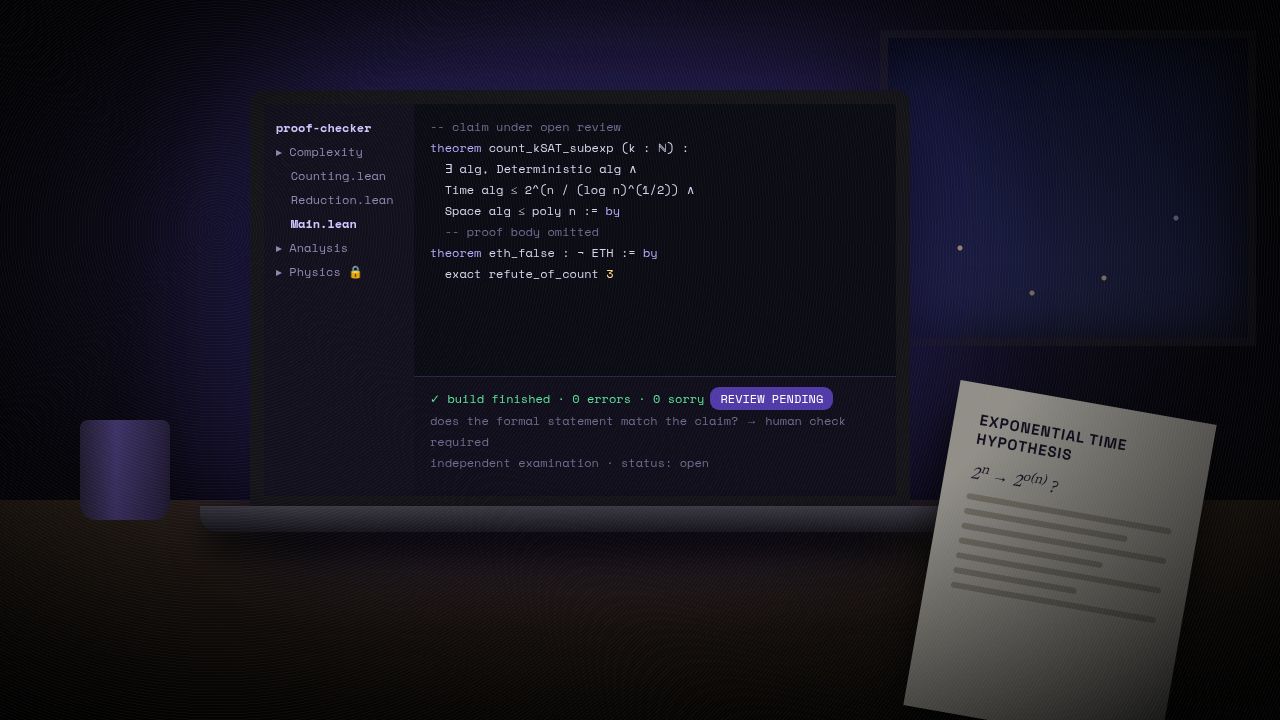
The Exponential Time Hypothesis, or ETH, is about 3-SAT. That’s the classic puzzle of deciding whether a set of true-or-false constraints can all be satisfied at the same time. Trying every assignment of n variables takes about 2n steps, and ETH says no algorithm can do fundamentally better than exponential time.
Most computer scientists believed it. OpenAI notes that ETH underpins “hundreds of papers” arguing that problems across graph theory, biology and databases can’t be solved much faster.
The AI-written paper, titled simply “The Exponential Time Hypothesis is False,” describes a deterministic algorithm that counts every satisfying assignment of a k-CNF formula (the general form of these puzzles) in subexponential time while using only a polynomial amount of memory. Williams summed up the claimed speed on X as roughly exp(n/(log n)1/2+o(1)) for 3-SAT. That’s faster than any 2cn bound, but still far from the “polynomial time” that would mean P = NP.
OpenAI says the model found the disproof on 16 October and it was formalised in Lean, a language for machine-checked proofs, the next day.
Who’s checking it matters. The review group is led by Russell Impagliazzo and Ramamohan Paturi of UC San Diego, who (with Francis Zane) originally proposed ETH, and by Williams, who has spent years probing it. Williams wrote that the group has “signed no NDAs and will receive no compensation” and asked OpenAI to release all its raw data on ETH. OpenAI agreed, and will fund a conference on the result.
Williams’s take is cautious but excited. “If true, their claim implies a variety of other NP problems now all have faster algorithms as well,” he wrote, adding that it “should make every computer scientist put at least a little more weight on the possibility of P = NP.” OpenAI says practical algorithms “will require significant further research.”
The math result: local smoothing, Kakeya and Stein
The second claim is in harmonic analysis. In 1991, Christopher Sogge proposed the local smoothing conjecture. Roughly, it says extreme focusing of waves can’t last: at a typical moment they behave far better than in the worst case. It implies two other famous problems, the Kakeya and Stein restriction conjectures.
Larry Guth, Hong Wang and Ruixiang Zhang proved local smoothing in two spatial dimensions in 2019, and Wang and Joshua Zahl proved the Kakeya conjecture in three dimensions in 2025. OpenAI now says its model proved local smoothing “in every dimension,” using a new auxiliary partial differential equation. The company says that also resolves the Kakeya and Stein restriction conjectures in all dimensions. Its GitHub changelog is more careful, saying Stein’s estimates hold “throughout the interior of the conjectured range.” The output, obtained on 18 October and formalised in Lean the next day, was released without a designated review team.
The physics claim: Yang–Mills and QCD, with an asterisk
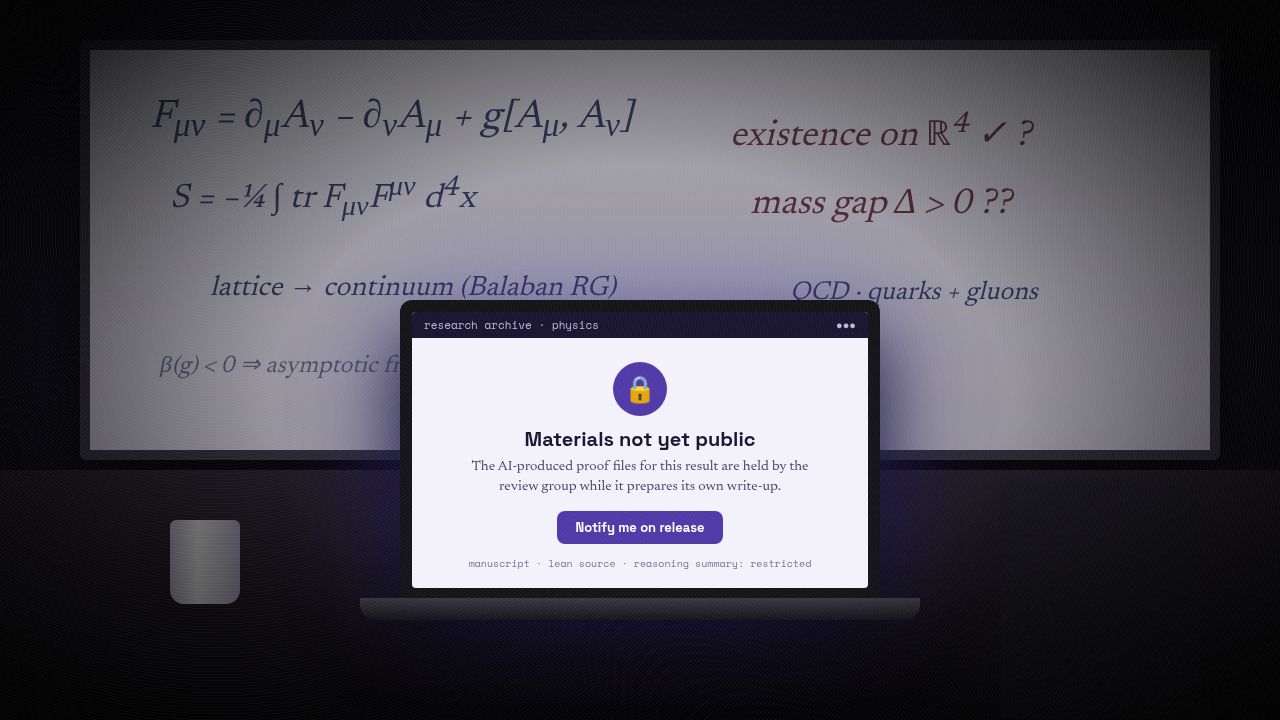
The third claim is the most ambitious and the least verifiable for now. OpenAI says its models produced “a mathematically rigorous existence proof” for certain four-dimensional quantum field theories, including quantum chromodynamics (QCD), the theory of quarks and gluons, and “a unified completion of the Standard Model.” Building on Tadeusz Balaban’s approach, it includes, as a sub-step, an existence proof for pure Yang–Mills theory.
Quantum Yang–Mills theory is one of the Clay Mathematics Institute’s $1 million Millennium Prize Problems. Clay’s problem asks for two things: that the theory exists, and that it has a “mass gap,” meaning its particles have positive mass. OpenAI says its proof covers “part” of the problem and doesn’t mention the mass gap. Clay’s website still lists the problem as unsolved.
OpenAI says the model produced the Yang–Mills proof on 9 September and the QCD proof on 18 September, and that it waited for a Lean formalisation, finished 16 October. A group led by Nobel laureate David Gross, with Michael Douglas, Arthur Jaffe, Igor Klebanov and Nikita Nekrasov, will shepherd the work. At the group’s request, the AI-produced material isn’t public yet.
Here the criticism is sharpest. Columbia’s Peter Woit wrote that “from this press release, it’s hard to know exactly what they’re claiming to have proved.” The Advisory Group on Mathematics and AI (AGMAI), an independent panel based at the Institute for Advanced Study whose advice OpenAI says it has drawn on, published a statement on 26 October calling on OpenAI to release the Yang–Mills outputs “without delay.” Its argument: OpenAI said it was waiting for the Lean formalisation, that’s now done, so “there is no scientific reason for delaying the release any further.”
Why the release process is its own controversy
This is OpenAI’s second big math drop in a month. On 6 October it released a GitHub repository of AI-written manuscripts that now holds 721 papers grouped into 373 families. According to the repository, the model was given about 4,000 problems, each result took an average of roughly three hours of ChatGPT Pro thinking compute, and about 42% of the top-line results have Lean formalisations.
Not everything survived. On 7 October, OpenAI withdrew three manuscripts after “a sign error” broke a key argument. AI-written proofs can be wrong, and a Lean check only proves what was actually formalised.
The bigger fight is about access. On 25 October, a day before this announcement, AGMAI said it recommends that AI companies “do not adopt” the practice of picking specific mathematicians to receive AI output first. It cited unequal access and biased selection. OpenAI’s new shepherd model partly answers that: the ETH group insisted everything go public at once. But the physics group will get material nobody else can see yet. OpenAI admits the tradeoff, writing that choosing shepherds “necessarily shapes who gets involved first and creates asymmetry of information.”
Credit is the other open question. The ETH group’s open letter asks how it should cover “checking, fixing, simplifying, explaining, and extending” AI results. Then there’s the model itself. OpenAI said on 6 October that it is “working to responsibly release the model that produced these results,” but hasn’t given a date. That caution fits a company that said last week it now trains its frontier models with no live internet access.
What it means and what to watch
For most people, nothing changes today. The claimed algorithm is subexponential, not polynomial, and practical gains are a long way off. The real stakes are scientific and commercial. A confirmed disproof of a conjecture this central would be one of the strongest signs yet that AI can do original research. Rivals racing to ship ever-stronger reasoning models will be measured against that.
It also matters for OpenAI’s business. Anthropic has just filed for its IPO, and a verified research breakthrough is the strongest pitch an AI lab can make that its next model is worth the money.
Watch three things: whether the Impagliazzo–Paturi–Williams group confirms or finds a gap in the ETH proof, whether OpenAI releases the Yang–Mills and QCD material as AGMAI demands, and whether anyone claims the Clay Institute’s mass gap prize. Nothing OpenAI published this week claims it.
Sources
- OpenAI: Working with academic communities to build scientific understanding (26 Oct 2026)
- OpenAI on GitHub: The Exponential Time Hypothesis is False (paper, revised 25 Oct 2026)
- OpenAI on GitHub: openai/math repository README and history
- OpenAI: Sharing AI progress in mathematics (6 Oct 2026, updated 15 Oct)
- Ryan Williams on X: thread on the open examination of the ETH claim (26 Oct 2026)
- AGMAI: Recommendation for immediate release of Yang–Mills AI output (26 Oct) and Disadvantages of designating mathematicians (25 Oct 2026)
- Peter Woit, Not Even Wrong: Secret Unified Physics Slop (26 Oct 2026)
- Clay Mathematics Institute: Yang–Mills and the Mass Gap
- The Verge: OpenAI announces three big science discoveries and a new way to work with academics (26 Oct 2026)
Leave a Reply