
The strongest AI models you can download and run yourself have mostly come from Chinese labs. On Thursday, a French company made its bid to change that.
Mistral released the weights of Mistral Large 4, the 1-trillion-parameter model it calls “Le Chonk,” on 29 October. Anyone can now download it from Hugging Face, change it and run it on their own servers. Mistral calls it the best open-weight model for coding. Independent testers at Artificial Analysis put it a little lower: the top open model built outside China, by a narrow margin.
The release has been one of the most-discussed AI stories of the past day. The Hacker News thread passed 1,250 points. X recorded about 1,000 posts mentioning “Mistral Large 4” on 29 October (UTC), up from 30 to 60 a day earlier in the week, and Mistral’s launch post passed 500,000 views in under a day. Here’s what it is, how it scores, and what it takes to run.
What Mistral actually released
Mistral Large 4 isn’t brand new. Mistral launched it as a public preview on 6 October, available through its API, and promised the weights by the end of the month. The version released this week is an improved one. Mistral says three more weeks of reinforcement learning, where the model practises on tasks and is rewarded for what works, brought “massive improvements in coding and defensive cybersecurity.”
According to the model card, the basics are:
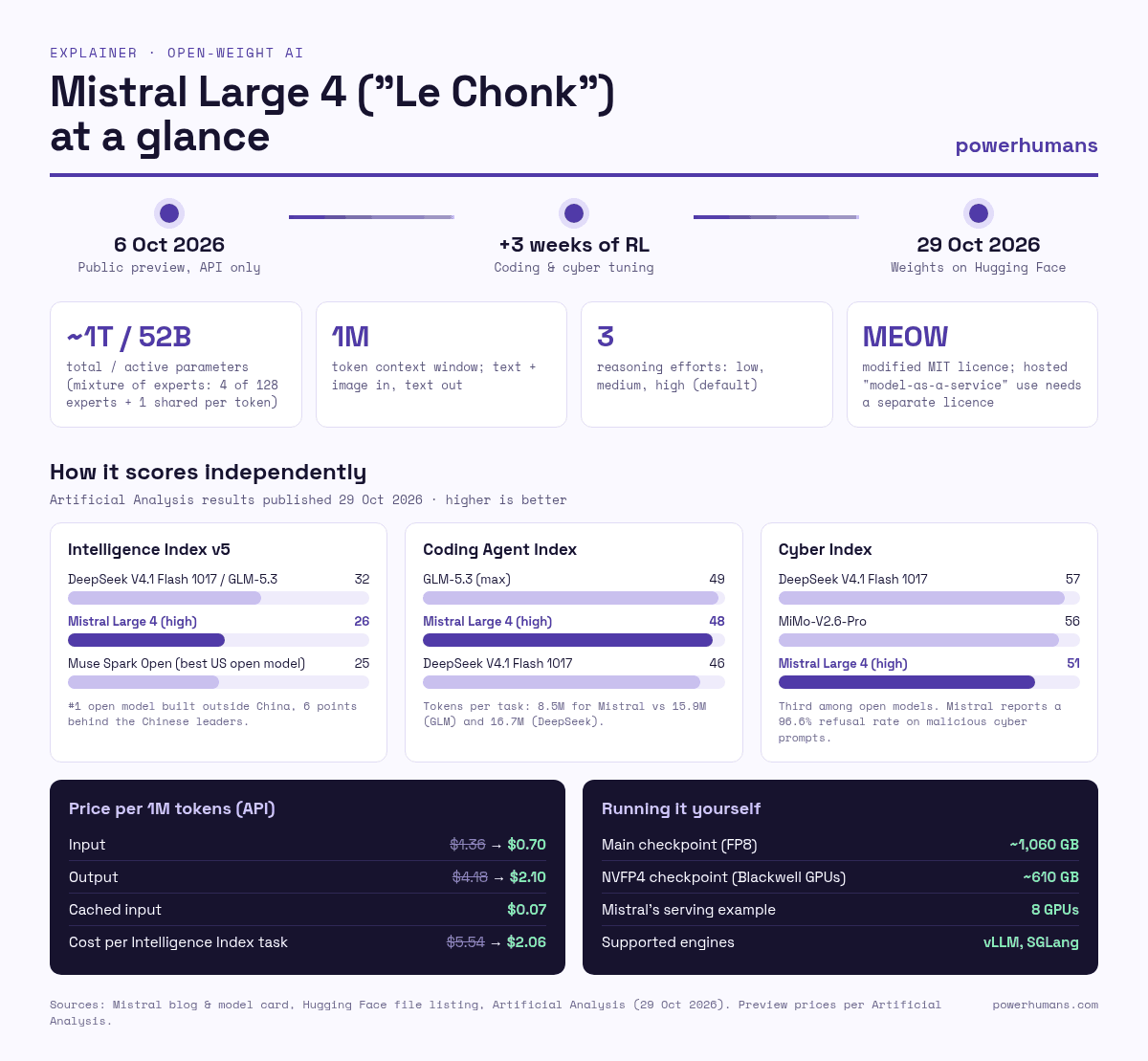
- Size: about 1 trillion parameters in total. It’s a mixture-of-experts design, so only about 52 billion are active for each token. Each token is routed to 4 of 128 “expert” sub-networks plus one shared expert.
- Context: a 1-million-token context window.
- Input: text and images in, text out.
- Reasoning: one model for chat and for reasoning, with three effort levels: low, medium and high (the default).
Mistral says the model was trained from scratch on 3,800 NVIDIA Grace Blackwell GPUs in its own European data centres. That’s central to the pitch: a model whose origins European banks and governments can trace.
There’s a catch in the word “open,” though. Mistral Large 4 uses the Mistral Ecosystem Open-Weight License, a modified MIT licence. It’s free to use, modify, fine-tune and sell products built on. But a company that offers the model as a hosted service needs a separate commercial licence from Mistral. One Hacker News commenter was quick to note that this makes it “weights available” rather than open source in the strict, OSI-approved sense.
Mistral’s numbers vs. the independent ones
Mistral’s announcement is full of benchmark wins, nearly all against other open models. The company says Large 4 leads open-weight models on Cognition’s private FrontierCode 2.0 test (19.7%) and on Terminal-Bench 4.0, where it says the score jumped from 28% in the preview to 41%. On the Artificial Analysis Coding Agent Index, Mistral says it scores 48%, “effectively tied” with China’s GLM-5.3 while using 47% fewer tokens per task.
Artificial Analysis, which runs its own tests, mostly backs the coding claim. Running inside Mistral’s Vibe coding tool, Large 4 scored 48 on its Coding Agent Index. That put it second among open models, between GLM-5.3 (49) and DeepSeek V4.1 Flash 1017 (46), while using about half as many tokens per task: 8.5 million against 15.9 million and 16.7 million.
On its broader Intelligence Index, the picture is less flattering. Artificial Analysis scores Large 4 at 26, up a single point from the preview. That puts it 1 point ahead of Muse Spark Open, the best US-built open model, but 6 points behind the leading Chinese open models, DeepSeek V4.1 Flash 1017 and GLM-5.3. On FrontierCode 2.0 as Artificial Analysis runs it inside that index, Large 4 managed 15%, against 29% for DeepSeek and 22% for GLM. The same benchmark can score very differently in different test setups, so neither number is necessarily wrong. But it’s a reason to treat a vendor’s charts as a starting point.
Two independent findings do favour the new version. Artificial Analysis says its hallucination rate on the AA-Omniscience test fell from 41% in the preview to 28%, and it uses 39% fewer output tokens per task. Closed models are still well ahead, though. Fortune points out that Anthropic’s Mythos 5.1 scored 60.9% on Terminal-Bench 4.0, the test where Mistral reports 41%.
The cyber pitch, and the worry that comes with it
Mistral’s tagline is “Built for Coders, Trusted by Defenders.” It says Large 4 scores 51% on the Artificial Analysis Cyber Index, which tests whether a model can find a vulnerability in a codebase, reproduce it and patch it without breaking anything. Artificial Analysis confirms the 51 but ranks it third among open models, behind DeepSeek V4.1 Flash 1017 (57) and MiMo-V2.6-Pro (56).
The argument behind it is about control. Closed models can refuse legitimate security work that looks like hacking, and a provider can cut off access. Fortune notes that a US export-control directive forced Anthropic to suspend two of its models for nearly three weeks in June. “Once you open source the weights, they’re all over the internet. It’s impossible to cut off access,” Pierre Stock, Mistral’s VP of science, told reporters, according to Wired. Stock also questioned whether Chinese open models can be trusted, telling Wired, “You have no guarantee that [Chinese models] won’t behave maliciously.”
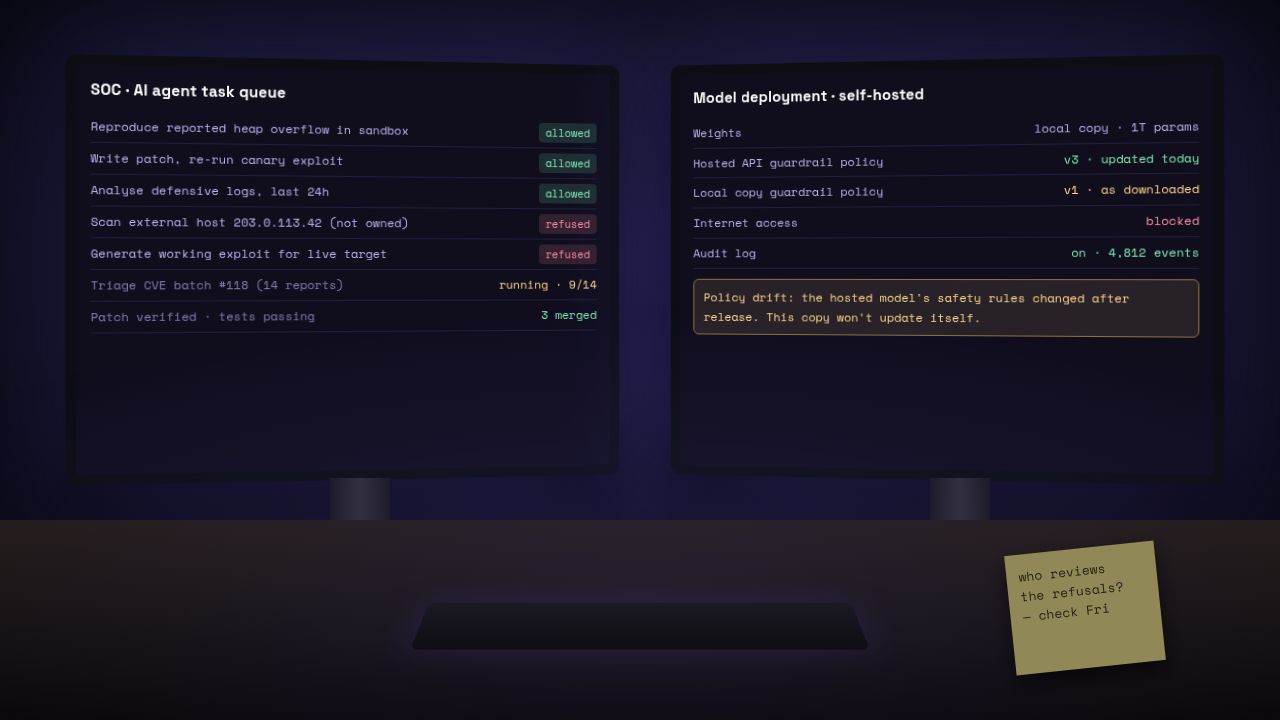
Being impossible to cut off cuts both ways. Mistral says Large 4 refuses 96.6% of malicious cyber requests on average across three public safety test sets, the highest rate it measured among open models. It doesn’t publish a matching figure for how often the model wrongly refuses legitimate work, which one Hacker News commenter pointed out. More notably, Mistral admits that after watching live traffic during the preview, “we see a potential for uplift to conduct real attacks,” and says it is changing its guardrails. Mistral can update the guardrails on its own API; copies people have already downloaded stay as they are. Mistral also says a specialised variant tuned for penetration testing and red-teaming is going only to vetted partners such as Orange Cyberdefense, under contract.
Rafe Pilling, a threat-intelligence director at Sophos, gave Wired the blunt version: “It’s clearly a dual-use technology.” It’s the same tension we saw when Google gave Gemini 4 Carbon to cyber defenders first, and that the ARTEX hacking-agent case made concrete.
What it costs, and what it takes to run
If you just want to use it, Large 4 is on Mistral’s API (as mistral-large-4), Mistral Studio, OpenRouter, NVIDIA-hosted endpoints and Microsoft Foundry. The price is $0.70 per million input tokens, $0.07 for cached input and $2.10 per million output tokens. Artificial Analysis says that’s roughly half the preview’s price of $1.36 and $4.18. By its count, one task in its Intelligence Index now costs $2.06, down 63%, though that’s still more than DeepSeek V4.1 Flash 1017 ($0.60) or MiMo-V2.6-Pro ($0.26).
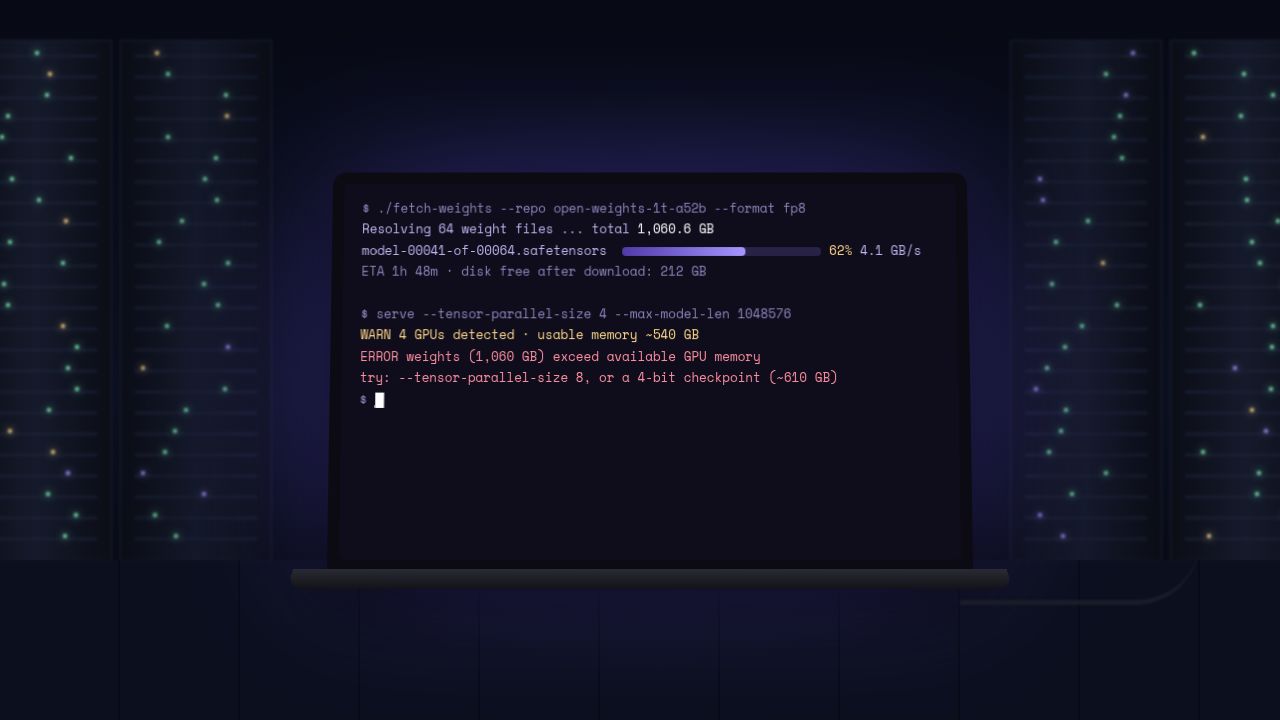
Running it yourself is a different matter. The main checkpoint on Hugging Face is about 1,060 GB of weight files. A compressed NVFP4 version, aimed at NVIDIA’s Blackwell GPUs, is still about 610 GB. Mistral’s own serving examples split the model across eight GPUs. One Hacker News commenter with four H200 cards (about 540 GB of memory) said it looked like they’d have to squeeze the model down to 3 or 4 bits to serve it. In other words, this is a model for companies with data centres, or for cloud providers, not for a gaming PC.
That suits the buyers Mistral is targeting. Banks including La Banque Postale, Crédit Agricole, ABN AMRO and Belfius are quoted in the announcement, alongside security firms such as CrowdStrike, Cloudflare and Zscaler. Their message is the same: they want a capable model they can host, inspect and keep running, whatever happens to someone else’s API.
The bottom line
Mistral Large 4 doesn’t beat the best Chinese open models across the board, and it doesn’t come close to the top closed models. What it offers is a trillion-parameter model trained in Europe, with weights you can keep, scores that are competitive on coding at a much lower token count, and a price that has just been cut in half. Last week Kimi K3.1 Pro showed how close Chinese open models have come to Claude. Now Mistral is giving Western buyers who won’t use those models an option of their own. The question is how much control is worth against a few benchmark points.
Mistral says a full technical report is “coming soon.” Until then, take the company’s own advice: run your own evaluations.
Sources
- Mistral: Mistral Large 4 (Le Chonk) is now open weight (29 Oct 2026)
- Mistral: Introducing Mistral Large 4 public preview (6 Oct 2026)
- Hugging Face: Mistral-Large-4-1T-A52B model card
- Hugging Face: Mistral-Large-4-1T-A52B-NVFP4 checkpoint
- Artificial Analysis on X: Mistral Large 4 independent results
- Artificial Analysis on X: Coding Agent Index results
- Artificial Analysis: Mistral Large 4 model page
- Mistral AI on X: weights release announcement
- Wired: Mistral says Le Chonk surpasses Chinese models in cybersecurity
- Fortune: Mistral releases Large 4 and claims top open model for agentic coding and cyber defense
- Hacker News discussion: We’re releasing the weights of Mistral Large 4


Leave a Reply