
Andrej Karpathy got fed up with YouTube on a Friday night. By Saturday he had his own version of it. The former Tesla AI director and OpenAI co-founder has launched HackerTube, a free video site built only from YouTube videos that Hacker News commenters have kept recommending to each other for almost 20 years. He says he didn’t write the code himself. Anthropic’s Claude Opus 5.5 did, in about two hours.
It has taken off fast. Karpathy’s Hacker News post passed 2,300 points and 540 comments, the top story on the site this weekend. His announcement on X had about 2.5 million views, more than 32,000 likes and over 28,000 bookmarks by Monday morning India time. X posts about it went from a few dozen an hour on Sunday to nearly 700 an hour after he posted, and they were still running at around 300 an hour overnight. A copycat site for books hit the Hacker News front page within a day. Here’s what HackerTube is, how it was built, and what it says about where AI coding is right now.

Why Karpathy built it
In his blog post, Karpathy describes opening YouTube at 11pm on Friday and finding “an enshittified wall of slop”: exaggerated thumbnails, the same tired recommendations, content he calls “idiocracy-grade.” He concedes the algorithm probably works for the median viewer, “but it definitely does not work for me.”
In the Hacker News thread he went further, arguing that people who want deep, long-form content are “a rounding error” in YouTube’s tests, so the recommendations drift toward everyone else’s taste. His take on modern thumbnails was blunter: “some guy looking like HOLY SHIT,” with an arrow pointing at something.
So on Saturday morning he gave Claude a one-line brief: build a YouTube clone using only the videos people have recommended on Hacker News.
What HackerTube actually is
HackerTube looks like YouTube, but the catalogue is fixed and hand-picked by the crowd, not by an engagement algorithm. According to the site’s own stats, it holds 6,454 videos drawn from 39,834 Hacker News comments by 15,041 different people, covering 2007 to 2026 and sorted into 150 topics across 16 areas. Think conference talks, university lectures, documentaries and deep technical explainers.
A few design choices stand out:
- No clickbait thumbnails. Each video shows a frame from exactly halfway through instead of the uploader’s thumbnail, which Karpathy says gives you “a representative frame.”
- No accounts. Likes, history and Watch later are stored only in your browser, and videos play through YouTube’s privacy-enhanced embed.
- Recommendations from people, not watch time. The home feed mixes “HN classics,” hidden gems, recent favourites and topics you haven’t explored, and hovering over a video tells you why it’s there. Every video page shows the real Hacker News comments about it, with links back to the threads.
- Search by meaning. The site says a search for “distributed systems” finds talks that never use those words.
It also kept changing while people used it. Within hours, Karpathy posted a changelog in the Hacker News thread: filters for upload date, length and video type, a “Recently recommended” sort, a like-ratio quality sort and a “Play all on YouTube” button, all requested by commenters. Asked whether “HackerTube Shorts” was coming, he replied: “NEVER. More inclined to add HackerTube Longs.”
How Claude built it
The site’s About page lays out the pipeline, and it’s the more interesting part of the story.
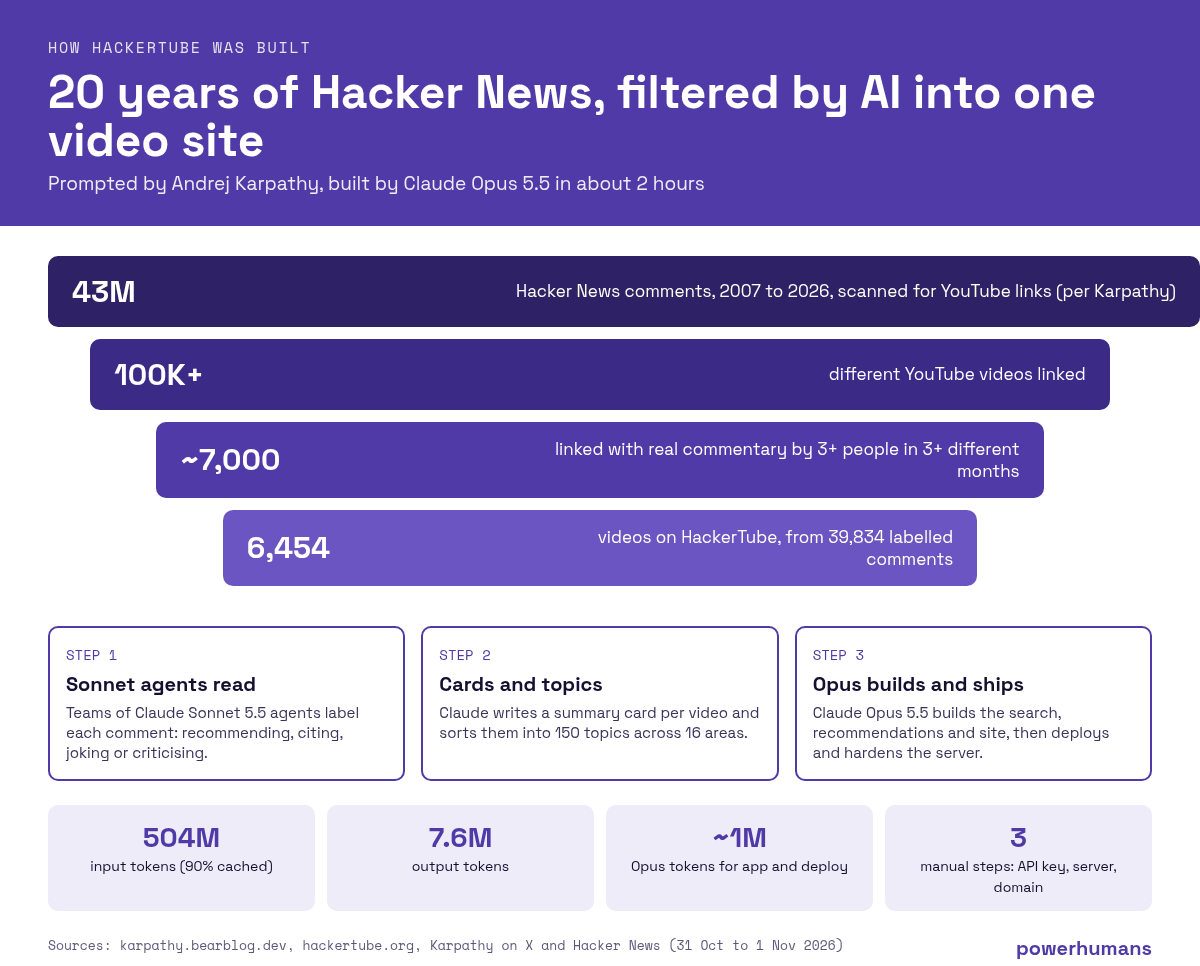
First, every Hacker News comment from 2007 to 2026, taken from a public archive of the site, was scanned for YouTube links. Karpathy put the total at 43 million comments. That turned up well over a hundred thousand different videos. To make the cut, a video had to be linked with some real commentary by at least three different people, in at least three different months, which left roughly 7,000.
Then the AI did the reading. Claude went through each comment, along with the title of the story it was posted under, and judged what the commenter was doing: recommending the video, citing it as a source, joking, or criticising it. It also pulled out a short quote and a few topics. Next, Claude wrote a card for every video, with a summary, why Hacker News readers like it, what kind of video it is and whether it has aged well. Videos are ranked by how many separate months people recommended them in, so a talk that gets linked again and again over the years beats one viral spike.
The work was split between models. The About page credits Claude Opus 5.5, working in Claude Code, with the data pipeline, search, recommendations and the site itself, while “teams of Claude Sonnet 5.5 agents” that Opus coordinated wrote the comment labels, video cards and topic list.
When a commenter asked what it cost, Karpathy said he’s on a subscription but had Claude add it up: 504 million input tokens (90% of them cached) and 7.6 million output tokens. More than 90% of that was Sonnet labelling comments. The app and deployment took about 1 million tokens of Opus 5.5. “Very small project by modern standards,” he wrote.
“I only talk to Claude”
The line that has drawn the most attention is in the update to Karpathy’s post. “I don’t actually do anything resembling traditional engineering anymore,” he wrote, meaning reading or writing code or running terminal commands. “I only talk to Claude and have it do everything.”
He says his only manual steps were creating a YouTube API key in Google Cloud, booting a VPS and buying the domain (plus its DNS record, he added in the thread). Once the server was up, he gave Claude the IP address and told it to “update, deploy, secure, harden and optimize” the code. He uses the Claude Code desktop app on a Mac with Opus 5.5 on medium effort.
He was also clear about the limits of that trust. When a commenter said they were probably overprompting and should take a more laid-back approach, he cautioned: “Only with Opus 5.5+. The thing is beast mode. I wouldn’t trust other weaker models this much.” And he hasn’t published the server code, calling it “a vibe coded mess.” That’s worth keeping in mind before you hand an agent the keys to a live server: Claude Code itself was hit by a tampered extension in Cursor’s marketplace only days ago, and Anthropic’s own research found that even experts follow an AI’s quiet judgment calls without noticing.
Build your own version
The part developers seem most excited about is that you’re invited to copy it. HackerTube’s About page offers a 17.8MB data download containing every video record, all 39,834 labelled comments, the topic list, “people also recommend” data and search vectors for semantic search, plus a DATA.md guide written for AI agents. It’s released under the ODC-By 1.0 licence, so you can use it for anything as long as you credit HackerTube.
The suggested workflow is to give the zip to an AI coding agent and ask for what you want, whether that’s a different interface, a weekly email of talks on your topics or a terminal browser. Karpathy says pointing Opus 5.5 at the zip and asking for a YouTube-like site is “basically instant,” taking him about three minutes. One catch: YouTube’s terms don’t allow redistributing its metadata, so you’ll need your own free YouTube Data API key to pull titles, durations and view counts.
People are already doing it. Less than a day later, Hacker News user roansh launched HackerBooks, about 16,500 books that at least two different commenters mentioned, also built with Opus 5.5. “Claude wrote almost all of it,” the creator wrote. That post passed 1,000 points.
Why it matters
HackerTube isn’t a YouTube competitor. It depends on YouTube for every video, and its catalogue only grows when Hacker News users keep recommending things. What makes it a big story is how ordinary it now looks for one person to build it. A crowd-sourced dataset of tens of thousands of human judgments, labelled by a team of AI agents, wrapped in a full web app and deployed to a hardened server over a weekend, for what Karpathy calls a small number of tokens.
It’s the same shift behind tools like GitHub’s Copilot Fusion and Anthropic’s move to drop the five-hour limit on its top Claude plan: AI coding is moving from autocomplete to agents that run whole projects while you supervise. Karpathy’s own advice on prompting is that it’s getting simpler. “My prompts are getting shorter and dumber because the model ‘gets’ what I’m doing,” he wrote. Give it too much detail, he says, and you can end up constraining a model that would have done something smarter.
For everyone else, the takeaway is simpler. If an algorithm feed isn’t working for you, building your own filtered version is no longer a team project. HackerTube is free to use now at hackertube.org.
Sources
- Andrej Karpathy: HackerTube (blog post, 31 Oct 2026)
- Andrej Karpathy (@karpathy) on X: HackerTube announcement (1 Nov 2026)
- Hacker News: HackerTube, YouTube built from videos recommended by HN
- Hacker News: Karpathy on token usage
- Hacker News: Karpathy on the data export and server code
- Hacker News: Karpathy on which models he trusts
- Hacker News: Karpathy on prompting
- Hacker News: Karpathy’s changelog from thread feedback
- HackerTube: site, About page and data export
- Hacker News: Show HN, HackerBooks




Leave a Reply