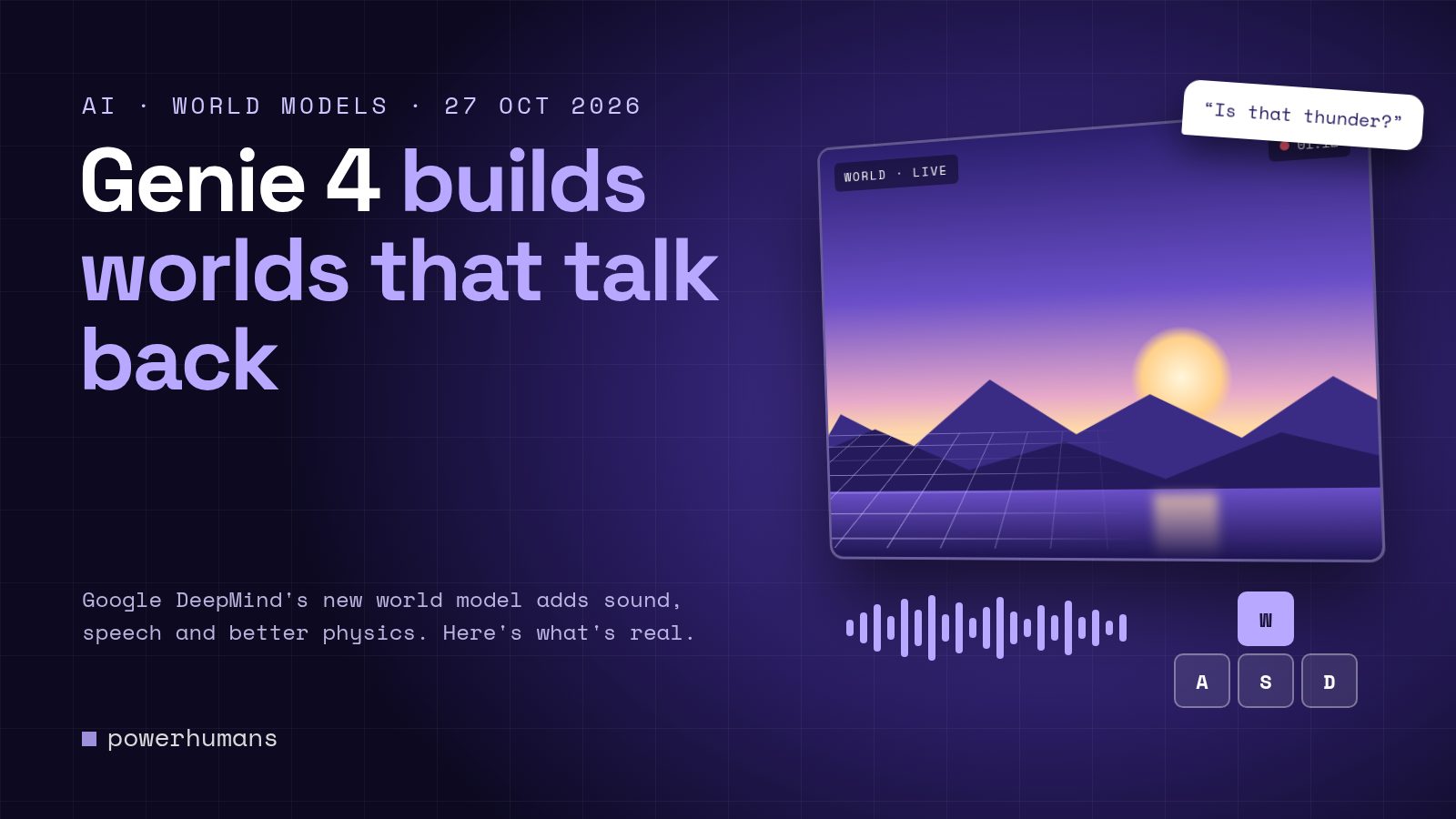
Google DeepMind’s newest model doesn’t write code or answer questions. It builds a world you can walk around in, and now that world can talk back. Genie 4, announced on Tuesday, 27 October (around 9:30 PM India time), is a “world model”: type a description or give it an image, and it generates an explorable scene frame by frame, in real time, as you move through it with a keyboard. What’s new is that the scene now comes with its own sound, more believable physics, people who move more naturally, and characters who can hold a conversation.
It was the most-discussed AI launch of the past day. Google DeepMind’s announcement post on X passed 1.9 million views in under 12 hours, and Sundar Pichai’s post passed 1.1 million. On Hacker News, the launch climbed to nearly 780 points and more than 470 comments. Here’s what Genie 4 does, what’s actually new, who can use it, and where it still falls short.
What is Genie 4?
A world model is different from a video generator. A video model renders a fixed clip. A world model generates the next moment based on what you do: turn left and it invents what’s to your left; walk back and it has to remember what was there. DeepMind describes understanding and simulating the world as “a crucial aspect of building AGI”, because it lets AI agents and robots practise in endless simulated environments.
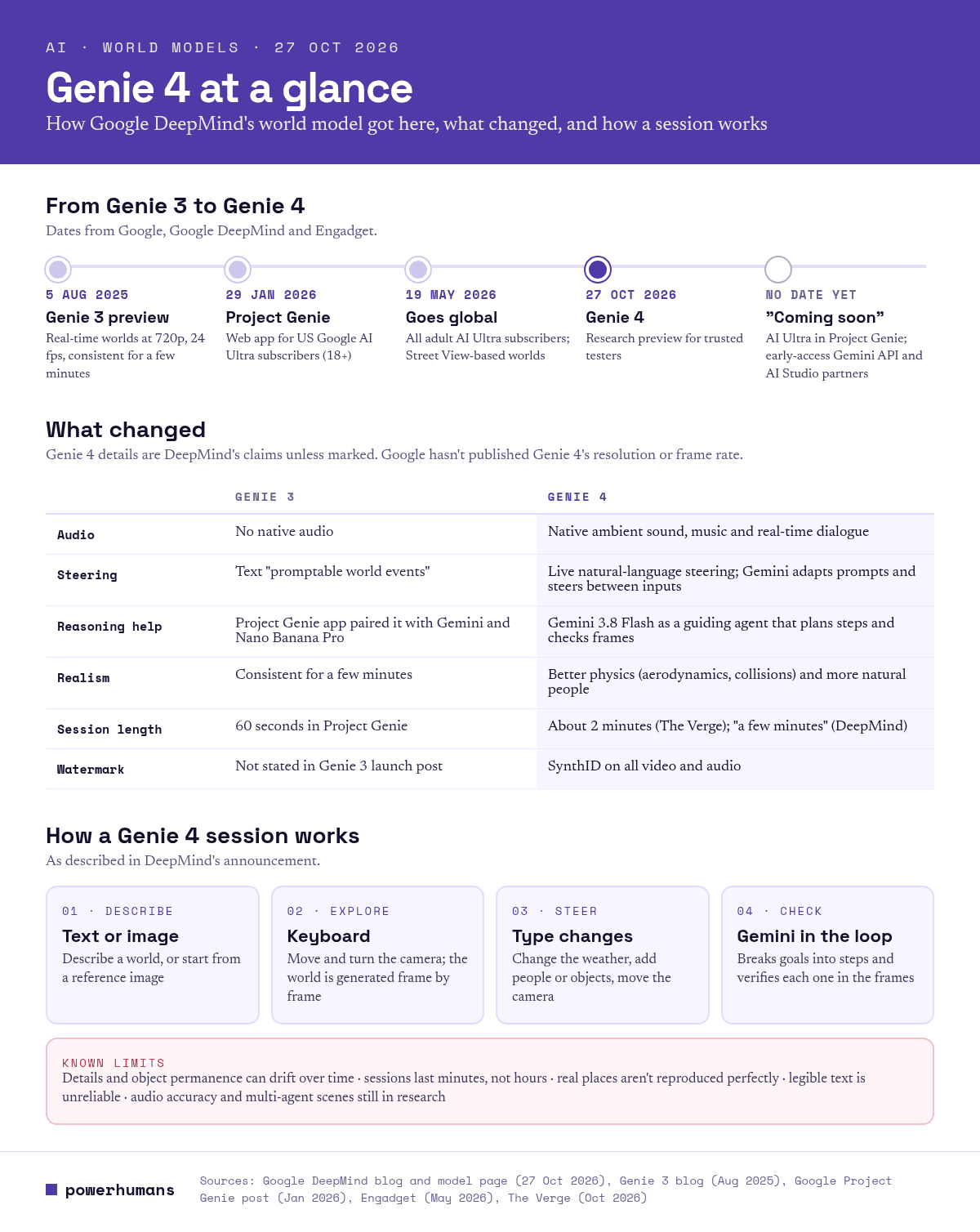
Genie 4 is the fourth version of the idea. Its predecessor, Genie 3, was previewed in August 2025 and could generate worlds at 720p and 24 frames per second that stayed consistent “for a few minutes”, according to DeepMind. In January 2026, Google turned Genie 3 into Project Genie, an experimental web app for US subscribers to its top-tier Google AI Ultra plan, which went global in May.
According to DeepMind’s announcement, Genie 4 “incorporates and builds on capabilities from the Gemini family”. Gemini Omni, which Google pitches as a model that can “create anything from anything”, “anchors the simulations in real-world appearance and behavior”, while other Gemini models handle the reasoning that keeps a simulation coherent over time.
What’s new in Genie 4
DeepMind groups the upgrades into four areas.
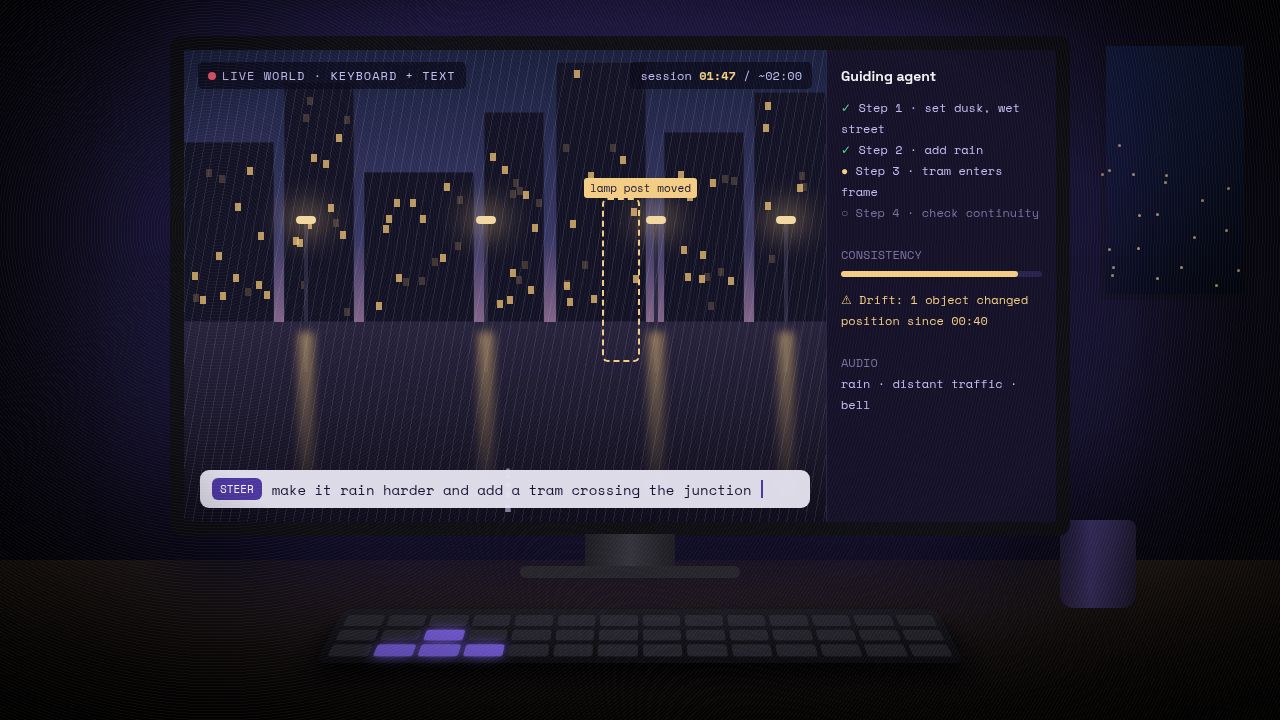
Live steering in plain language. While you’re inside a world, you can type instructions such as changing the weather, moving the camera or adding a new person or object. DeepMind says Gemini “will contextually adapt your prompt to match the surrounding scene”, and keeps steering the world between your inputs so it doesn’t fall apart. Genie 3 already supported text-triggered “promptable world events”; the difference now is Gemini actively managing the scene.
More realistic physics and people. DeepMind claims Genie 4 better simulates things like aerodynamics and collisions, and calls its handling of people “the most dramatic leap”: characters that “move naturally, respond organically to their environments, and can be interactively steered in real-time”.
Native audio, including speech. This is the headline feature. Genie 4 is DeepMind’s “first real-time world model to generate audio natively”, so each world has its own ambient sound, such as wind, waves or footsteps. It also generates dialogue: characters “converse and react to your inputs or events in the world, all in real-time.”
A Gemini agent in the loop. Under the hood, Gemini 3.8 Flash acts as what DeepMind calls a “guiding agent”. As Genie 4 renders, Gemini watches the scene, breaks a goal into steps, and checks incoming frames to confirm each step happened. If you interrupt, it changes the plan. DeepMind says this is what makes multi-step events and cause-and-effect more reliable.
Session length has improved too. The Verge, briefed by Google, reports that Genie 4 can create experiences about two minutes long, up from one minute in the Genie 3-powered Project Genie. DeepMind’s own model page is vaguer, saying it supports “a few minutes of continuous interaction”. Google hasn’t published Genie 4’s resolution or frame rate.
Why robots are part of the pitch
The flashy demos are dragon flights, a stained-glass landscape and a saxophonist on a floating platform. But the more telling demo is a robot. DeepMind paired Genie 4 with Gemini 4 Argon to simulate Apptronik’s Apollo humanoid robot playing checkers. Argon breaks the task into steps and feeds them to Genie 4 as text captions while the scene renders, so the simulation can adjust as the task progresses.
That’s the long-term bet. If a world model can generate realistic, endlessly varied scenes, robots and AI agents can be trained and tested in situations that would be slow, costly or dangerous to set up for real. DeepMind’s model page calls this “an infinite playground for robotics simulations” and also mentions using Genie worlds to teach its SIMA game-playing agent new skills. It’s the same direction as AI that works on your behalf, like OpenAI’s computer-using GPT-6.1 Terra, but pointed at the physical world instead of a screen.
Who is testing it, and for what
Genie 4 isn’t public yet. DeepMind says it has been working with trusted testers in creative industries, journalism, education, gaming and engineering, and describes four early uses:
- Film pre-visualisation. Filmmakers can step into a draft of a scene and run several “takes”, changing camera angles, lighting, dialogue and action on the fly.
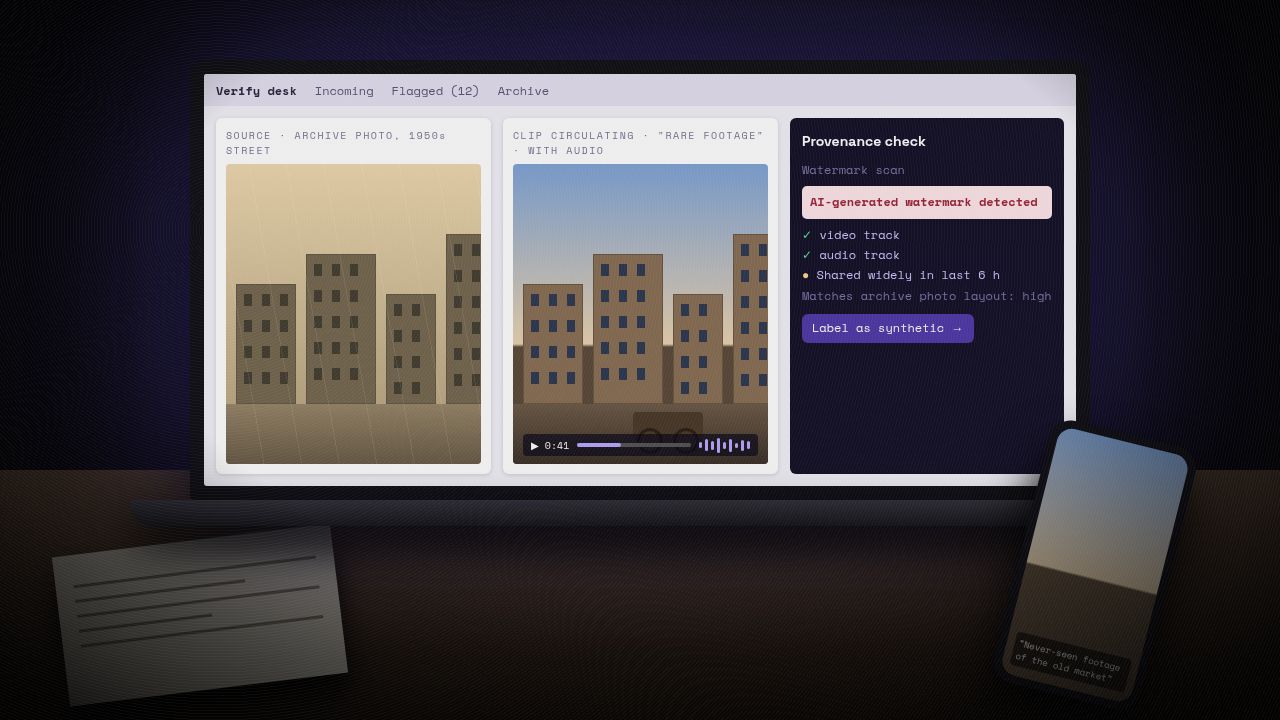
- Historical scenes. Photojournalists are testing how a single archival photograph can become an explorable simulation of that place, or how a flash flood or wildfire might unfold.
- Game prototyping. Developers are going from an idea to an explorable prototype “in seconds”, before writing engine code.
- Enterprise simulation. Companies are evaluating it for quick “zero-to-one” scenario generation.
The game angle carries some history. Ars Technica notes that Genie 3’s reveal last year “sent gaming stocks tumbling”. DeepMind frames Genie 4 as a prototyping and simulation tool rather than a replacement for game engines, and its announcement doesn’t mention exporting a playable game or 3D assets.
The catch: realism cuts both ways
The same features that make Genie 4 useful also make it worth watching. A model that can turn an archival photo into a scene with moving, speaking people is a powerful tool, and an obvious source of convincing fake footage. Voice AI is already blurring the line, as we saw with Block’s eerily human-sounding Dessa.
DeepMind says Genie 4 has “strict safety guardrails” in line with its other models, went through internal safety evaluations before the preview, and is going to trusted testers first on purpose. It also says all video and audio from Genie 4 will carry SynthID, Google’s invisible watermark for identifying AI-generated content. That helps where people check for it, but a watermark only matters if platforms and viewers actually look.
The model also has clear limits, and DeepMind lists them:
- Visual details and object permanence can “shift or drift” over time, especially in longer sessions, after several complex prompt edits, or while moving around a scene.
- Sessions last a few minutes, not hours.
- It can’t simulate real-world locations with perfect accuracy.
- Legible text usually only appears if it’s in the original description.
- Complex physical interactions, real-time audio accuracy and scenes with several independent agents are still being worked on.
Early reaction has been mixed. On Hacker News, commenters were impressed by some demos but pointed to physics that didn’t hold up, such as a falling object that should have toppled, a character’s tone that didn’t match the scene, and footage that, in one commenter’s words, “still looks like a video game rendering”. Others asked whether you can export what you build. Since nobody outside the tester group can try it yet, those judgements are based on Google’s own selected clips.
When can you try Genie 4?
Not yet, unless you’re a trusted tester. Google says Genie 4 is “coming soon” to Google AI Ultra subscribers through Project Genie, and to early-access partners of the Gemini API and Google AI Studio. There’s a waitlist on DeepMind’s site. Google hasn’t announced a date or developer pricing, and Ars Technica reports there’s no specific timeline.
If you already pay for AI Ultra, joining the waitlist costs nothing. If you’re a developer thinking about simulation or game prototyping, it’s worth applying for early API access, but plan around a model that DeepMind itself calls “early” and “experimental”. And if you watch a lot of video online, treat Genie 4 as a reminder of where things are going: realistic, interactive, talking scenes are moving from research demos towards a product people can buy. It’s also another sign of how fast the frontier labs are moving, in the same week that OpenAI claimed its AI had refuted a major conjecture in computer science.
Sources
- Google DeepMind: Genie 4, a new generation of world simulation (27 Oct 2026)
- Google DeepMind: Genie 4 model page (capabilities and limitations)
- Google: We’re announcing Genie 4 (27 Oct 2026)
- Google DeepMind: Genie 3, a new frontier for world models (5 Aug 2025)
- Google: Project Genie, experimenting with infinite, interactive worlds (29 Jan 2026)
- Engadget: Project Genie goes live for global AI Ultra users (19 May 2026)
- The Verge: Google’s next Genie AI model generates more realistic experiences (27 Oct 2026)
- Ars Technica: DeepMind unveils Genie 4 world model (27 Oct 2026)
- Google DeepMind on X: Genie 4 announcement (27 Oct 2026)
- Hacker News: Genie 4 discussion
Leave a Reply